
Battery Locomotives BEV
Zero-emission haulage built for the tight clearances, sharp curves, and constant maneuvering of tunnel construction and shunting work. No exhaust, no added ventilation load, no compromise on pulling power.
- Max. pull force (kN)
- 10 – 68
- Max. power (kW)
- 2×12 – 2×110
- Weight (t)
- 4 – 30
- Gauge (mm)
- 500 – 1,200
Why battery locomotives for tunnel & shunting work
-
Zero local emissions
no exhaust fumes to extract, meaning lower ventilation capacity and running cost in a tunnel where air quality is already a constrained resource
-
Compact, configurable dimensions
cabin height, width, and length adjust to fit your tunnel's clearance profile, not the other way around
-
Precise low-speed control
frequency-converter-driven motors give the fine, responsive handling shunting work demands: tight spotting, repeated coupling, careful positioning around TBM logistics and muck trains
-
Quiet operation
no combustion engine noise, easier on crews working in an enclosed, acoustically harsh environment
-
Tight curve capability
curve radii down to 10 m suit the confined geometry of tunnel sidings and portal areas
-
Manned or fully autonomous
run it with a driver during active construction phases, or automate repetitive shunting cycles once the route is fixed
Technical description
Every battery locomotive is built around maintenance-free, three-phase asynchronous motors from 12 to 110 kW, each with its own frequency converter — giving the precise, independent power control that tunnel shunting needs, where every meter of positioning counts. Power reaches the wheels through a two-axle chassis with interchangeable, rubber-suspended castors, built to handle the repeated start-stop cycles of shunting duty without excess wear.
Safety runs on two independent systems: electrodynamic braking as the primary system, backed by a friction brake for parking — critical in tunnel sections where gradients and limited sightlines leave no margin for error. Inside, a state-of-the-art lithium battery pack with a custom BMS keeps performance and safety in balance, while the driver gets real-time status on an onboard display.
Need it fully automated? Our locomotives are built to run with a driver onboard or completely autonomously — useful once a tunnel's shunting pattern becomes fixed and repeatable.
Basic parameters
We build to your operation, not the other way around. Total weight scales from 4 up to 30 t, with one or two cabins — fixed or removable, sized to fit your tunnel's loading gauge. Track gauge adjusts from 500 to 1,200 mm, handling gradients up to 35‰ and curve radii down to 10 m — tight enough for portal areas and tunnel sidings. Rated for -10°C to 40°C operation.
Low-maintenance by design: premium batteries and a sophisticated frequency converter mean less downtime and lower total cost of ownership — important when access for servicing is itself limited underground.
Full technical range
| Max. pull force (kN) | 10 – 68 |
|---|---|
| Batteries | Customized lithium technology battery packs, per customer requirements |
| Max. power (kW) | 2×12 – 2×110 |
| Weight (t) | 4 – 30 |
| Gauge (mm) | 500 – 1,200 |
| Max. curve radius (m) | 10 – 20 (according to locomotive size) |
| Axles | 2 |
| Max. speed (km/h) | 18 – 20 |
| Max. cabin height (mm) | 1,800 or custom |
| Max. width (mm) | 1,300 or custom |
| Max. length (mm) | 5,500 or custom |
Our machines in the workshop and in operation
Locomotives & rolling stock for every underground and industrial route

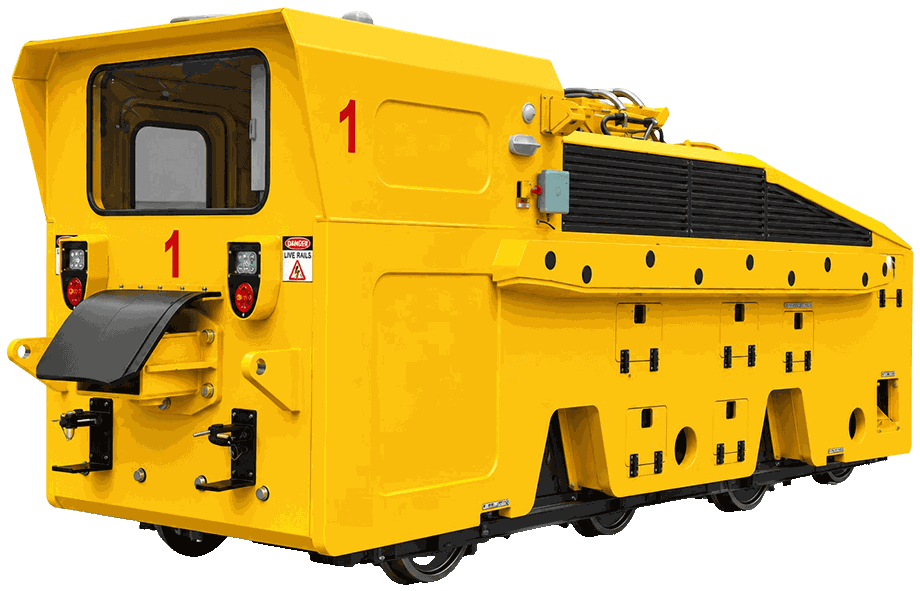

Every tunnel has its own clearance profile, gradient, and shunting pattern. Tell us the constraints you're working within and we'll design a locomotive that fits — literally and operationally.
Need the wagons too? We design and build matching ore cars, passenger cars, and other rolling stock — so you get a complete transport system, not just the locomotive.
Request a quote
Have a project that doesn't fit a standard spec sheet? That's most of what we do.
Business development enquiries, technical questions, or a quick chat about your project — reach out directly.