
Rolling Stock Crane
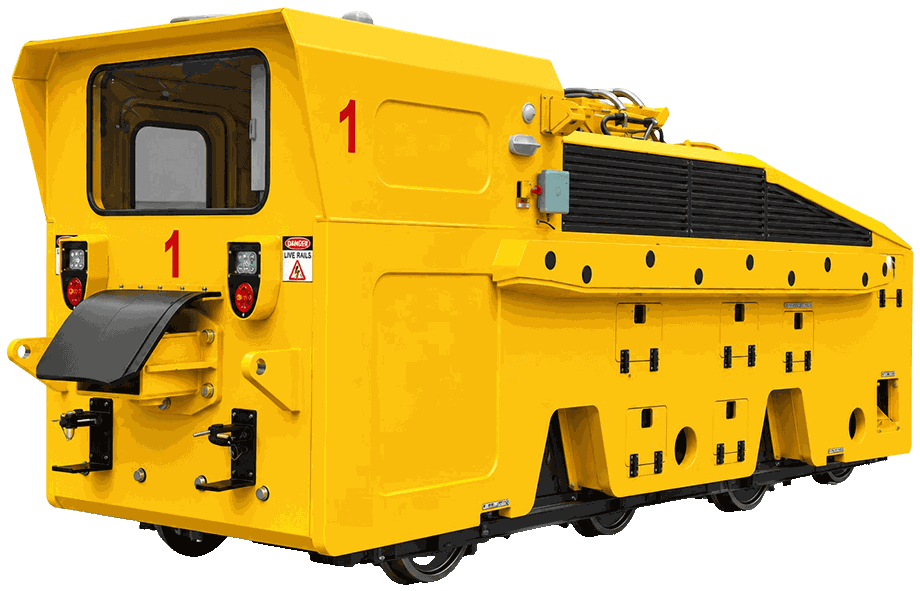
A rail-mounted crane built to re-rail rolling stock and handle lifting work underground or on the surface — its own locomotive, its own crane, one machine. When something comes off the track, this is what puts it back.
- Gauge (mm)
- 750
- Operating weight (t)
- 18
- Axles / driven
- 3 / 2
- Max. pull force (kN)
- 21
Why our rolling stock crane
-
Purpose-built for re-railing
designed specifically to lift derailed locomotives and wagons back onto the track, on top of general underground lifting and transport work
-
Full crane arm reach
telescopic boom extends to a working length of up to 5.5 m, rotates ±45°, and lifts to a working height of 4.9 m, covering a 9.5 m² work area
-
Serious lifting capacity
hook capacity up to 9.0 t, with winch pull from 3.0–4.0 t up to 8.0 t depending on configuration
-
Stable under load
four hydraulic outrigger legs stabilize the machine during lifting, with automatic lockout if any leg loses ground contact
-
A mobile workshop, not just a crane
onboard compressor and welding unit mean field repairs don't wait for a second vehicle to arrive
-
Dual independent braking
hydraulic and mechanical systems on both driven axles, with automatic emergency shutdown on fault conditions
-
Rated for real underground conditions
operates on gradients up to 35‰, in temperatures from -20°C to +40°C, humidity up to 100%
Technical description
The DL 18C-750 is built in two sections: a cab housing the engine bay and running gear, and a second section carrying the crane equipment itself, operated from the cab. The cab includes full controls, monitoring, and an LCD display; the crane section has lighting and a camera monitoring system.
Power comes from a water-cooled, three-cylinder DEUTZ engine, flexibly mounted in the locomotive frame with a two-stage exhaust cleaning system (catalytic converter plus liquid scrubber tank). Torque reaches the wheels through a hydrostatic drive — a hydraulic pump connected to the engine via a flexible coupling, driving a hydraulic motor on the axle gearbox — giving continuously variable, reversible speed control from 0 to 18 km/h under load in either direction.
The chassis runs on three axles, with the second and third linked by a cardan shaft; wheels are fitted with replaceable rims and mounted in roller bearings. Spring suspension uses rubber-metal blocks at each wheel, independently sprung in every direction. Braking runs on two fully independent systems on both axles: a hydraulic brake through the hydrostatic drive, and a mechanical, dual-circuit brake acting directly on the wheel tread via spring force and lever mechanism, controlled by a proportional servo valve with manually adjustable maximum force. In an emergency, the parking brake can be released manually to allow towing.
An automatic shutdown system stops the engine (via intake throttle and fuel cutoff) if hydraulic system pressure drops below 1.0 MPa, engine oil pressure drops below 0.11 MPa, engine temperature exceeds 115°C, or the driver presses STOP — and reduces the engine to idle if coolant temperature exceeds 105°C, hydraulic oil temperature exceeds 85°C, the intake filter clogs, or coolant level drops.
Crane arm and winch. The boom is a box-section single-telescope arm on a slewing turntable with hydraulic rotation drive, with the winch mounted at the rear. Winch pulling capacity ranges from 3.0–4.0 t (minimum) up to 4.0–8.0 t (maximum), and the boom delivers up to 9.0 t on the hook at maximum extension. Transport height is 1,600 mm; working height reaches 4.9 m.
Stabilization. Four hydraulic outrigger legs ground the machine during crane operation. If any leg loses ground contact, the system automatically locks out crane function — only the telescope adjustment needed to restore ground contact remains active.
Onboard equipment. A hydraulically driven compressor (0.4 m³/min at 10 bar) and a hydraulically driven welding set (continuous duty 40%/400 A, with 230 V/4.0 kVA and 400 V/10.0 kVA sockets, plus protective equipment and electrodes) are built in — field repairs and fabrication work without a second vehicle.
Cab. Robust construction with a forward-facing, cushioned, sprung seat with adjustable suspension, antistatic upholstery, and seatbelt. A protective mesh screen for the windscreen is available on request. Full lighting (main beam, dipped, and rear red) plus an acoustic alarm are standard, alongside a sanding system operable from either cab, in both directions of travel.
Fire suppression. A centralized CO₂ system, triggered from the driver's cab, protects the main fuel valve, injection pump, and intake system, backed by a manual extinguisher under the seat.
Basic parameters
This configuration is built to a 750 mm gauge and 18 t operating weight as a reference model — talk to us about adapting gauge, dimensions, and lifting capacity to your site and rolling stock.
Full technical range
Reference configuration: DL 18C-750 — figures below describe this specific model, not a size range.
| Gauge (mm) | 750 |
|---|---|
| Operating weight (t) | 18 |
| Axles / driven | 3 / 2 |
| Max. pull force (kN) | 21 |
| Speed, continuously variable (km/h) | 0 – 18 |
| Length (mm) | 4,600 |
| Width (mm) | 1,350 |
| Height (mm) | 1,600 |
| Rail clearance (mm) | 215 |
| Wheel diameter (mm) | 580 |
| Min. curve radius (m) | 12 |
| Engine | DEUTZ F3L 2011, 30 kW continuous, 2,300 rpm rated |
| Max. torque (N·m) | 245 (at 1,600 rpm) |
| Electrical system (V) | 24 |
| Battery | 2 × 12 V, 150 Ah |
| Boom length, max. (m) | 5.5 |
| Boom working length (m) | 4.0 / 5.5 |
| Telescope extension (m) | 1.5 |
| Boom rotation | ±45° |
| Working area (m²) | 9.5 |
| Max. lift height (m) | 4.9 |
| Max. hook capacity (t) | 9.0 |
| Winch pull, hook (t) | 3.0 – 4.0 (min) / 4.0 – 8.0 (max) |
| Onboard compressor | 0.4 m³/min at 10 bar |
| Onboard welding set | 40%/400 A continuous duty |
Locomotives & rolling stock for every underground and industrial route


Tell us your gauge, target lifting capacity, and site conditions, and we'll configure a rolling stock crane to match — or scale this configuration to your fleet.
Request a quote
Have a project that doesn't fit a standard spec sheet? That's most of what we do.
Business development enquiries, technical questions, or a quick chat about your project — reach out directly.